
Michel de Broin + Ève K. Tremblay : Honeymoons |

 |
ÈVE K. TREMBLAY | MICHEL DE BROIN Honeymoons, 2004 Catalogue couleur comprenant des essais bilingues d'Eduardo Rallickas et Udo Karl de Sauriac 48 p. : 38 ill. ; 24 x 17 cm ISBN 2-9808695-0-3 DISPONIBLE |
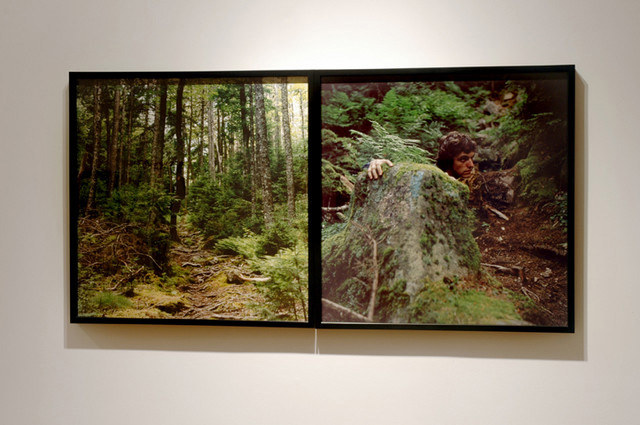
ABOUT THE SHOW | WORKS PRESENTED | VIEWS OF THE SHOW | ARTICLES | LINKSABOUT THE SHOWIn Honeymoons, artists Eve K. Tremblay and Michel de Broin team up to produce a photographic work exploring the tension that animates the encounter of two singular worlds.
What comes out of this duo's artistic project is a captivating exploration of the invisible topography of love. Conceptual Love [La promesse de l'image] Eduardo Ralickas © 2004
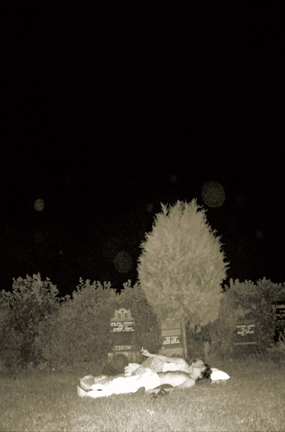
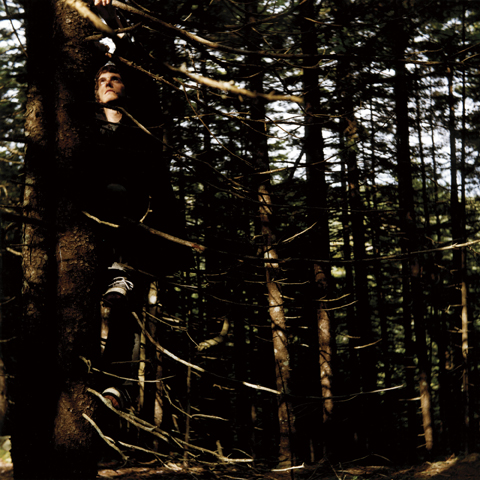
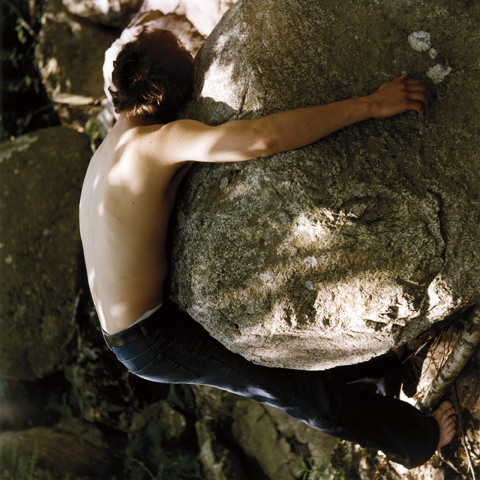
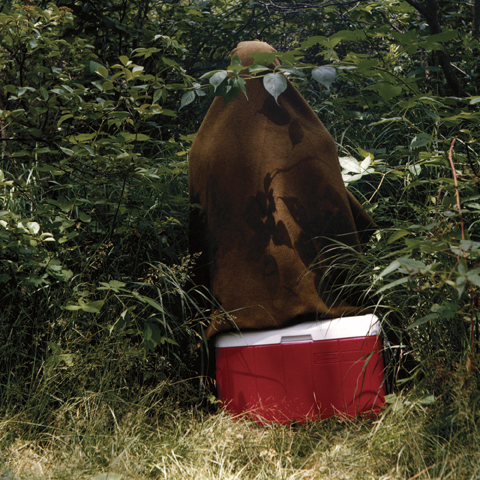
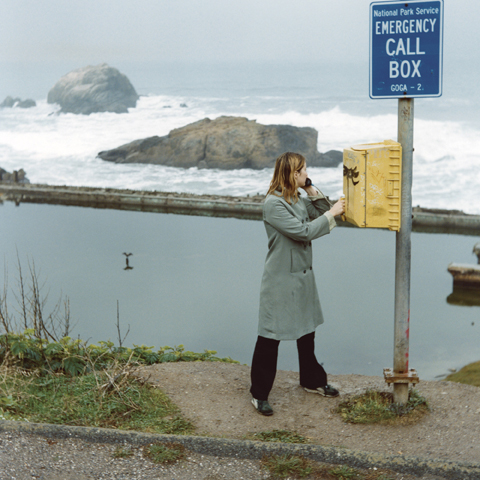
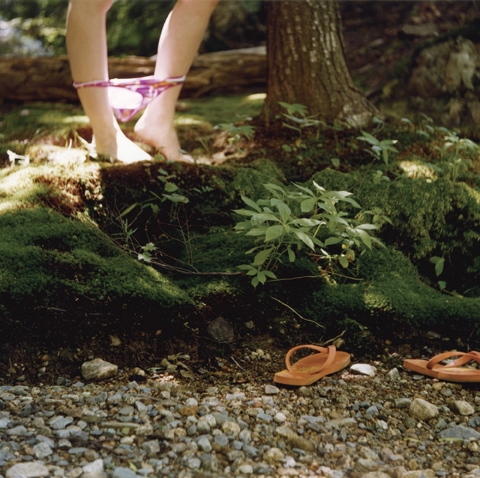
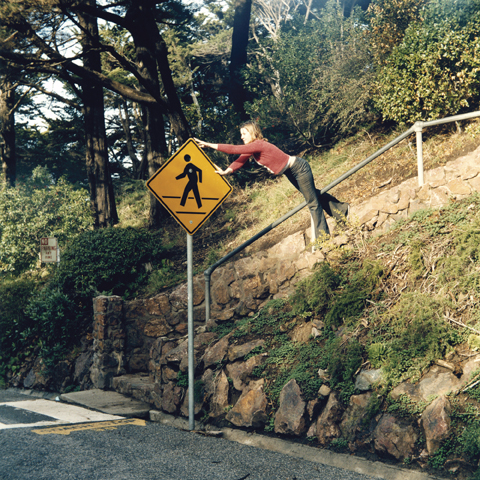
Jacques Lacan, "Love and the Signifier"1 Conceptual Love Although it is tempting to examine the images in Honeymoons in terms of a rigorous analysis of the concept of love, perhaps by making surreptitious references to Roland Barthes' critique of amorous discourse, I have chosen to forego entirely these enticing yet predictable textual filters. In keeping with my wish to avoid well-worn paths so as to offer the reader some insights that may be useful in approaching the works themselves, I have sought to remain faithful to the seductive tableaux at hand instead of applying a predetermined and perhaps ill-conceived hermeneutical agenda upon them. I have my reasons. In fact, I believe that throughout the history of modern thought, many singular jugglers of the rational kind have carelessly attempted to wed the sensuous and the conceptual, thereby giving rise to indigestible syntheses and other chimera. It is deplorable that with the aid of convoluted periphrases and tortuous circumlocutions, the philosophical tradition has consumed innumerable nuptials under the aegis of the love of wisdom. Perhaps fittingly, if this love has failed to measure up to the object of its affections, the blame may lie in the manner in which philosophy has courted its beloved: the love of wisdom has invariably been partial to the sphere of the concept, thereby fashioning a discourse that has embraced a concept of love and not the thing itself. Given that I lack the requisite talents for rational acrobatics, in what follows, I will focus mainly on the plastic effects of the sentiment of love that have been given shape in the works at hand. Put differently, I will examine the materiality of love at play in the photographs of Honeymoons, in which one can discern a clear tendency to flirt with the slick look of conceptual art. It is not within a philosophical corpus that one will encounter traces of conceptual love, but rather within a recent body of work produced by two artists whose collaborative efforts have disclosed the figurative powers of love. In the Honeymoons series, love is at once the starting point and the medium through which a teleological narrative is made manifest; it is also the ideal underpinning a practice that has yielded a myriad of images created with love and whose subjects are amorous through and through. This overabundance of the sentimental is not tautological, for the Honeymoons project openly stages the affective aspects of amorous experience themselves and traces their proliferations as they breed signs, figures and forms in various plastic languages. Succinctly put, the gesture of love in Honeymoons is the vehicle through which the Symbolic is laid bare for all to see. ‘I' Promise… We are undoubtedly in the presence of two dissimilar artistic practices: Ève K. Tremblay is known for staging distinctive photographic tableaux populated by a cast of idiosyncratic protagonists, while Michel de Broin is recognized for creating subversive sculptural works that resist facile categorizations. And yet their partnership in Honeymoons has resulted in a surprisingly homogeneous series of photographs that both strives towards a hybrid aesthetic and attempts to intertwine their respective plastic strategies, while maintaining a delicious degree of tension between them. Indeed, Honeymoons has been authored by two artists who have acknowledged their mutual fascination for the realm of the Other and whom Cupid has brought together to make up—this fact cannot be overlooked given the present context—a couple. At play in these works is the highly theatrical characterization of a pair of lovers whose union is comprehended as a project. It is important to grasp what is at issue in this notion of unity qua project, for the intelligibility of many images is at stake. Simply put, project indicates that we are in the midst of striving and of suffering; to carry out a project [pro-jet] implies that the ultimate fusion long awaited for is perpetually cast out [jeté devant], like a stream of water [tel un jet] towards infinity. In other words, completion always slips away. The resulting temporal disjunction is the very site—this last word is appropriate when speaking of the geography of love—of a ceaselessly renewable repetition of nuptial scenes. In truth, repetition is the means by which the topos that structures the entire series is brought to light (namely, the encounter); it is the embodiment of this narrative element as it is rehearsed over and over again in endless permutations. Ultimately, if "repetition requires novelty and in so doing turns towards the playful, which appropriates novelty into its own domain,"2 one could posit that Honeymoons narrates the enactment of a staged union, and that the story, which always changes yet always remains the same, promises to deliver the Subject. What is one to make of the narrative topos of the encounter? The playful nature of words is quite helpful in the present context, since I hold that the encounter does not take place at all— for it has no place (the topos is dystopian). Conversely, if this couple meets on any common ground, their encounter occurs in an empty space they both somehow occupy and which is at the origin of all their acts of longing and sharing that have been made visible in the photographs. Their encounter is fostered by a non-space that conditions their isolated, protracted gazes. The geography of their love is a topography of absence, which has given shape to the nuptial pilgrimage sites they have not ceased to frequent. Without a doubt we are dealing here with a subjectivity traversed by lack whose fulfilment is at best wanting. Unity here is duplicitous. It is a double act. The scenography of Honeymoons is driven by a desire to bridge an inalienable gap between self and Other. In Honeymoons, love is an act of translation that betrays its own insecurities, its moments of uncomfortable silence, and its inadequacies to overcome the rift that is constitutive of all communication. Hence these photographs bring into view the painful path that leads to the Other and which is the cause of so much grief. Much like the inaugural chord of a musical work whose entire subsequent development is a quest for resolution, the first photograph of the series is quite eloquent (see Honeymoon SF8 [Vertigo]). In it two images of art-historical significance easily coalesce: Caspar David Friedrich's Wanderer above the Sea of Fog (c. 1818) and The Sea of Ice (c. 1823–25). Notwithstanding the fact that we are dealing here with an agitated liquid ocean (as opposed to a gaseous or frozen one) in front of which two people stand in place of the German painter's lone drifter, the comparison is far from trivial. The convergence of form betrays a striking convergence of content, insofar as the first instance of conjugal union in Honeymoons functions as a metonym for Friedrich's anonymous man, thereby subtly introducing the theme of the pair's subjectivity (or perhaps of the partial subject) and the modalities of its photographic representation. In fact, it is striking to realize how such a small number of Honeymoons' images depict the young lovers together within a single space. In light of this, the reference to Friedrich's reflective Wanderer—which represents subjectivity contemplating its own activity—is certainly not gratuitous. The significance of this citation is enhanced by the reference to the other canvas, whose central theme revolves around disaster and loss. In the ensuing conjunction of meanings is cast the very leitmotiv of the photographic series itself: Honeymoons epitomises a narrative of long-awaited synthesis. The photographs are thus conceived as heralding the advent of a promised Subject; however, if in its very first instance on stage it finds that it is the subject of division, the entire game will consist in fashioning the conditions leading to the renewal of its self-acquaintance. Self-encounters of the Imaginary Kind Is it not remarkable to note the overabundant presence of a wild, untrammelled nature in these photographs, in which will be played out many a timid approach to the magnetic Other, or in which we can witness both our lovers aping private rituals of love?
1. Jacques Lacan, The Seminar of Jacques Lacan: On Feminine Sexuality, The Limits of Love and Knowledge: Book XX, trans. Bruce Fink (New York and London: W.W. Norton & Company, 1998), p. 47. 2. Jacques Lacan, Les quatre concepts fondamentaux de la psychanalyse , ed. Jacques-Alain Miller (Paris: Seuil, 1990), p. 72. 3. For the sake of clarity, I would like to note that in this image, Ève K Tremblay's hand and Michel de Broin's head are the sole components of a seemingly entire person. WORKS PRESENTED
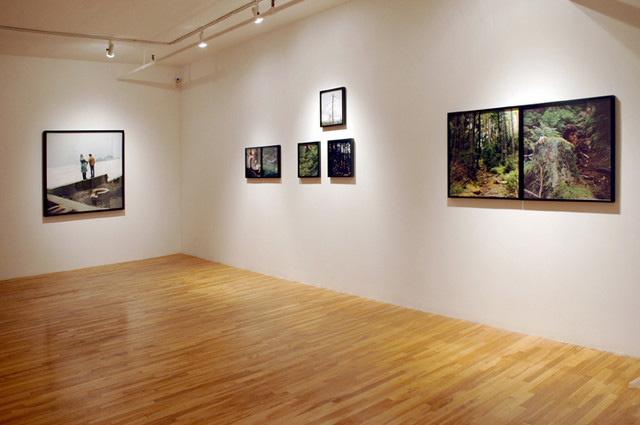
VIEWS OF THE SHOW
ARTICLESCampbell, James D. Bordercrossings, "Visual Art: Ève K. Tremblay and Michel de Broin", Issue 93, p86-89 Lamarche, Bernard. Le Devoir, Moi et l'autre, Saturday November 20, and Sunday November 21 2004, E8 Lehmann, Henry. The Montreal Gazette, Portraits of love and intimacy: Artists approach love from very different angles, Dec 11, 2004 ( 614 words) H2 Delgado, Jérôme. La Presse 2, Histoires de couples, December 9 2004 Dejardins, Eloi. L'artichaut: journal des étudiants en arts de l'UQAM, Lune de miel d'enfer ou comment Michel de Broin et Ève K. Tremblay ont envisage leur Mois de la Photo, Vol III no 2, December 2004 – Jan 2005 Lamarche, Bernard. Le Devoir , D'histoire et d'exotisme, Saturday, August 28 and Sunday, August 29, 2004 LINKS |













_______
contact